

Artificial intelligence is transforming how businesses operate, people communicate and industries make decisions. From generative AI tools and cloud computing to machine learning applications and digital services, modern technology increasingly depends on powerful computing infrastructure.
Behind these digital experiences are data centers: large facilities containing servers, storage systems, networking equipment and cooling infrastructure that process and store enormous amounts of information.
For years, data centers operated largely outside public attention. However, the rapid expansion of artificial intelligence has changed their visibility. Governments, technology companies and investors are committing substantial resources to building larger facilities capable of supporting increasingly demanding computing workloads.
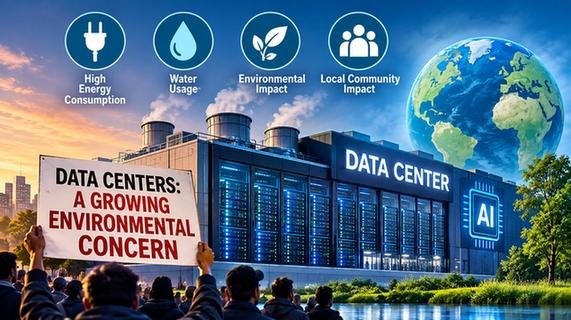
At the same time, communities are raising questions about electricity consumption, water availability, environmental sustainability, noise pollution and the financial impact of these developments.
The growing discussion is no longer limited to how quickly technology companies can build additional computing capacity. It increasingly concerns how that infrastructure affects the communities and resources surrounding it.
Understanding the environmental impact of data centers is therefore essential for businesses, policymakers, technology professionals and anyone interested in the future of artificial intelligence.
What Are Data Centers and Why Are They Expanding So Quickly?
A data center is a physical facility designed to house computing equipment that stores, processes and distributes digital information.
These facilities support services that people and organizations use every day, including:
- Cloud storage and enterprise applications.
- Online banking and digital payments.
- Video streaming and social media.
- E-commerce platforms and websites.
- Artificial intelligence and machine learning.
- Business databases and cybersecurity systems.
Traditional data centers already required significant electricity to operate servers and maintain suitable temperatures. However, the increasing adoption of artificial intelligence has introduced additional infrastructure requirements.
AI models require substantial computing power for training, development and everyday inference tasks. High-performance graphics processing units (GPUs) and specialized computing equipment generate considerable heat and require reliable electricity and cooling systems.
As businesses integrate AI into their operations, technology providers are investing in additional computing capacity.
The International Energy Agency’s October 2026 report, Powering Artificial Intelligence, identifies the rapid growth of data center investment as an important challenge for electricity systems. It highlights concerns involving electricity affordability, grid capacity, emissions and water use.
This expansion creates economic opportunities, but it also raises questions about whether infrastructure development is keeping pace with available energy and environmental resources.
Why Are Data Centers Becoming a Major Public Concern?
The growing resistance to data center construction is connected to something straightforward: these facilities have physical consequences for the locations where they operate.
People may experience artificial intelligence through websites, applications and smartphones, but data centers occupy real land and depend on local infrastructure.
Their effects can become visible through several important factors.
1. Rising Electricity Demand
Electricity consumption is one of the biggest concerns surrounding modern data centers.
Servers must operate continuously to provide reliable digital services. Cooling systems, networking equipment, lighting and backup infrastructure also require electricity.
AI-focused facilities can have particularly demanding power requirements because specialized computing hardware performs intensive workloads.
According to Lawrence Berkeley National Laboratory’s 2025 update to its United States Data Center Energy Usage Report, data centers could account for approximately 11.8% of total US electricity consumption by 2030. The report presents a scenario range of 9.5% to 15.3%.
These are projections rather than guaranteed outcomes, but they illustrate the potential scale of future electricity demand.
Rapid growth in electricity consumption can create challenges for regional power systems, especially where transmission infrastructure and generation capacity are already constrained.
For local communities, the central question becomes whether new electricity demand could contribute to higher power costs or require infrastructure investments that affect existing customers.
The actual impact depends on local electricity markets, utility planning, generation capacity and how data center operators pay for additional infrastructure.
2. Water Consumption and Cooling Requirements
Water is another important consideration when evaluating the environmental impact of data centers.
Computing equipment generates heat during operation. Facilities must remove that heat to prevent overheating and maintain reliable performance.
Some data centers use cooling systems that rely on water evaporation. These systems can provide effective cooling, but their water requirements may become a concern in regions experiencing drought or water stress.
The issue is particularly important because water availability varies significantly between locations.
A facility operating in a water-rich region may have a different environmental impact from an otherwise similar facility constructed in an area where households, agriculture and businesses already compete for limited water resources.
The IEA’s World Energy Outlook 2026 highlights the geographical concentration of data center water consumption. Its analysis estimates that approximately 30% of existing and planned global data center capacity is located in areas experiencing high water stress.
This demonstrates why national or global water consumption figures cannot fully explain the effects of individual projects.
Local water availability, seasonal conditions, cooling technology and the source of water must all be considered.
3. Noise Pollution and Local Quality of Life
Data centers are not simply quiet buildings containing computer equipment.
Their operation involves cooling fans, ventilation systems, transformers, generators and other mechanical infrastructure.
Depending on facility design and location, these systems can produce continuous background noise.
Residents living close to large facilities may become concerned about noise levels, construction activity, traffic and changes to the surrounding environment.
Although these issues may appear less significant than electricity consumption, they can directly influence how communities experience new infrastructure developments.
Proper site selection, equipment placement, sound barriers and environmental assessments can help reduce these effects.
4. Land Use and Environmental Pressure
Hyperscale data centers can require substantial land, electricity connections, cooling infrastructure and supporting construction.
As technology companies expand their infrastructure, communities may question how land is being used and whether proposed developments align with local planning priorities.
The environmental implications extend beyond the physical building.
Construction requires materials, electrical equipment, networking infrastructure and transportation. Semiconductor manufacturing and hardware supply chains also have environmental footprints.
Therefore, evaluating sustainability requires looking beyond a facility’s operational electricity consumption.
A comprehensive assessment should consider construction, equipment manufacturing, operation, maintenance and eventual hardware replacement.
Why Is the AI Boom Making the Problem More Visible?
Artificial intelligence has become an important driver of data center investment.
Generative AI systems process large amounts of information and rely on specialized computing infrastructure. As adoption increases, providers need additional capacity to support training and inference workloads.
However, not every AI application has identical computing requirements.
A small text-generation request, a complex reasoning task, an image-generation process and a large-scale model training operation can involve very different computational workloads.
The electricity requirements also depend on model architecture, hardware efficiency, utilization rates, cooling methods and data center design.
This distinction matters because broad statements about AI energy consumption can be misleading when they do not explain the workload being measured.
The growing demand for computing infrastructure has also increased public attention on where facilities are constructed and how their resource requirements are managed.
In its November 22, 2026 article, TechCrunch explored this growing resistance through an interview with journalist Paris Marx, author of Hyperscale.
The discussion highlighted how electricity bills, water access, noise and limited transparency can turn data center construction into a community-level issue.
The important point is that public concerns are not necessarily opposition to technology itself. They frequently involve the scale, location, management and accountability of infrastructure projects.
How Data Center Expansion Can Affect Local Communities
The relationship between data center construction and local communities is complex.
A new facility may create investment, construction opportunities, tax revenue and demand for supporting services.
However, the benefits and costs are not always distributed equally.
Pressure on Local Electricity Infrastructure
Large facilities require dependable power supplies.
If a region experiences rapid growth in electricity demand, utilities may need to invest in generation, substations, transmission lines and grid upgrades.
The financial consequences depend on regulatory arrangements and how infrastructure costs are allocated.
Policymakers therefore need to ensure that the costs associated with new industrial electricity demand are appropriately assessed.
Competition for Water Resources
Water-intensive cooling can create concerns in areas where freshwater resources are limited.
Local governments should evaluate existing water availability, projected demand and the potential effects on residential and agricultural users before approving large developments.
Employment and Economic Development
Data centers can attract investment and generate construction employment.
They also require specialized workers for engineering, security, networking, operations and maintenance.
However, employment opportunities vary by project and location. The number of long-term operational jobs may differ considerably from temporary construction employment.
Communities should therefore evaluate employment commitments alongside infrastructure and environmental requirements.
Transparency and Public Trust
People are more likely to question developments when important information is difficult to access.
Communities may want to understand:
- How much electricity will the facility require?
- What cooling technology will it use?
- Where will its water come from?
- Who will pay for grid improvements?
- What environmental assessments have been completed?
- How will noise and other local impacts be controlled?
Providing clear answers before construction begins can help reduce uncertainty and improve public participation.
Can Sustainable Data Center Technology Reduce Environmental Impact?
Although data center expansion creates challenges, technology and operational improvements can help reduce resource consumption.
Sustainability should be treated as a design requirement rather than an additional feature introduced after construction.
Several approaches can make a meaningful difference.
1. More Energy-Efficient Computing Equipment
Efficient processors, servers and storage systems can help reduce electricity consumption for particular computing workloads.
Technology companies can improve efficiency by selecting suitable hardware, optimizing software and avoiding unnecessary computing activity.
Virtualization and workload consolidation can also improve the utilization of existing infrastructure.
The objective should be to deliver more useful computing output with fewer resources.
2. Advanced Cooling Systems
Cooling technology has a significant influence on data center efficiency.
Operators can consider different solutions depending on climate, equipment requirements and local resource availability.
Examples include:
- Air-side and water-side economization.
- Direct liquid cooling.
- Closed-loop cooling systems.
- Improved airflow management.
- Heat recovery and reuse.
- More efficient fans and pumps.
No cooling system is universally suitable for every location.
For example, reducing direct water consumption through alternative cooling methods may increase electricity requirements in some configurations.
Operators must therefore evaluate the combined energy and water implications rather than focusing on a single sustainability metric.
3. Renewable Energy Integration
Renewable electricity can help reduce the carbon intensity associated with data center operations.
Solar, wind and other low-carbon electricity sources can contribute to more sustainable power supply arrangements.
However, purchasing renewable energy certificates or signing electricity agreements does not automatically mean that a facility receives renewable electricity at every hour.
The timing, location and reliability of electricity supply matter.
Companies should explain how their renewable energy commitments translate into actual electricity procurement and emissions reductions.
4. Waste Heat Recovery
Computing equipment produces heat that must be removed from server rooms.
Instead of treating all generated heat as waste, some facilities can explore opportunities to reuse it.
Potential applications include district heating networks, nearby commercial buildings and suitable industrial processes.
The practicality of heat recovery depends on temperature levels, infrastructure availability and the distance between data centers and potential users.
5. Transparent Environmental Reporting
Accurate measurement is essential for meaningful sustainability improvements.
Operators should report relevant indicators, including:
- Power Usage Effectiveness (PUE).
- Water Usage Effectiveness (WUE).
- Energy consumption.
- Renewable electricity usage.
- Carbon emissions.
- Waste heat recovery.
The European Union has introduced reporting requirements and a common framework for data center sustainability indicators.
These approaches can improve visibility and help policymakers compare facilities using consistent measurement methods.
What Should Technology Companies Do to Address Public Backlash?
Technology companies cannot rely exclusively on infrastructure investment and technical innovation to address community concerns.
They also need responsible planning and meaningful engagement.
Prioritize Responsible Site Selection
Before selecting a location, companies should evaluate electricity availability, water stress, land use, environmental sensitivity and existing infrastructure.
Choosing a location with suitable resources can reduce conflicts and improve long-term operational reliability.
Explain Infrastructure Costs
Companies should clearly communicate how new electricity demand will be managed and who will finance the necessary infrastructure improvements.
This can help prevent uncertainty about whether existing electricity customers will bear additional costs.
Share Water and Energy Information
Publicly accessible environmental information can improve accountability.
Where commercially sensitive information must remain confidential, companies should still provide meaningful aggregate information about resource consumption and environmental performance.
Involve Communities Early
Consultation should begin before important development decisions are finalized.
Residents should have opportunities to ask questions, review relevant assessments and understand the potential benefits and disadvantages.
Measure Results Instead of Making Broad Promises
Sustainability claims should be supported by measurable performance data.
Companies should communicate their electricity consumption, water requirements, emissions and efficiency improvements using clearly defined reporting periods and measurement boundaries.
Trust develops when commitments can be independently evaluated.
The Future of Data Centers: Growth Must Be Balanced With Responsibility
Data centers will remain essential to the digital economy.
Businesses need computing infrastructure to operate cloud services, develop AI applications, secure information and deliver digital products.
The challenge is not simply deciding whether additional facilities should be built.
It is determining how infrastructure can expand without placing unreasonable pressure on electricity systems, water resources and surrounding communities.
Governments have an important role in developing appropriate planning standards, improving transparency and ensuring that infrastructure costs are fairly allocated.
Technology companies must invest in efficient equipment, responsible cooling, cleaner electricity and measurable environmental improvements.
Communities also need access to reliable information so they can participate meaningfully in decisions affecting their surroundings.
Ultimately, the success of the AI industry should not be measured only by the number of models developed or data centers constructed.
It should also reflect how efficiently technology uses resources, how responsibly infrastructure is managed and whether the benefits of technological progress are shared fairly.
The future of artificial intelligence depends on more than advanced chips and powerful servers. It also depends on building the physical infrastructure that supports digital innovation in a responsible and sustainable way.
Frequently Asked Questions (FAQs)
1. Why are data centers facing growing public backlash?
Data centers are facing increasing public scrutiny because of concerns about electricity consumption, water usage, noise pollution, land requirements and possible effects on local electricity costs. Communities also want greater transparency about how these facilities are planned and operated.
2. How do AI data centers affect electricity consumption?
AI data centers use electricity to operate specialized computing equipment, storage systems, networking infrastructure and cooling systems. Training and running AI models can require substantial computing resources, although actual consumption varies by workload, hardware and operational efficiency.
3. Why do data centers consume so much water?
Some data centers use water-based cooling systems to remove heat generated by servers. Evaporative cooling can consume water during operation, making the location and availability of freshwater important considerations.
4. Are data centers harmful to the environment?
Data centers can contribute to electricity demand, carbon emissions, water consumption, electronic waste and land-use pressures. Their environmental impact depends on factors such as energy sources, cooling technologies, equipment efficiency, location and operational practices.
5. Can renewable energy make data centers more sustainable?
Renewable energy can help reduce the carbon intensity of electricity used by data centers. However, sustainability also requires efficient computing equipment, responsible cooling, transparent reporting and attention to electricity availability throughout the day.
6. What is a hyperscale data center?
A hyperscale data center is a large computing facility designed to support substantial workloads and scalable digital services. These facilities are commonly operated by major cloud providers and technology companies and can contain extensive server and networking infrastructure.
7. What is Power Usage Effectiveness (PUE)?
Power Usage Effectiveness is a data center efficiency metric calculated by dividing total facility energy consumption by the energy consumed by IT equipment. A lower PUE generally indicates that a smaller proportion of total facility energy is used for supporting infrastructure such as cooling and power distribution.
8. How can data centers reduce their environmental impact?
Data centers can improve sustainability through efficient hardware, workload optimization, advanced cooling, renewable electricity, heat recovery, responsible water management and transparent environmental reporting.
9. Why is data center location important for sustainability?
Location determines the availability and environmental impact of electricity, water and land resources. A facility constructed in a water-stressed region or an electricity-constrained area may create different challenges from one built where suitable infrastructure and resources are readily available.
10. Will AI growth increase demand for data centers?
Continued AI adoption is expected to support additional investment in computing infrastructure. However, the amount of new capacity required will depend on AI adoption, hardware efficiency, model development, workload optimization and the economics of operating data centers.
