

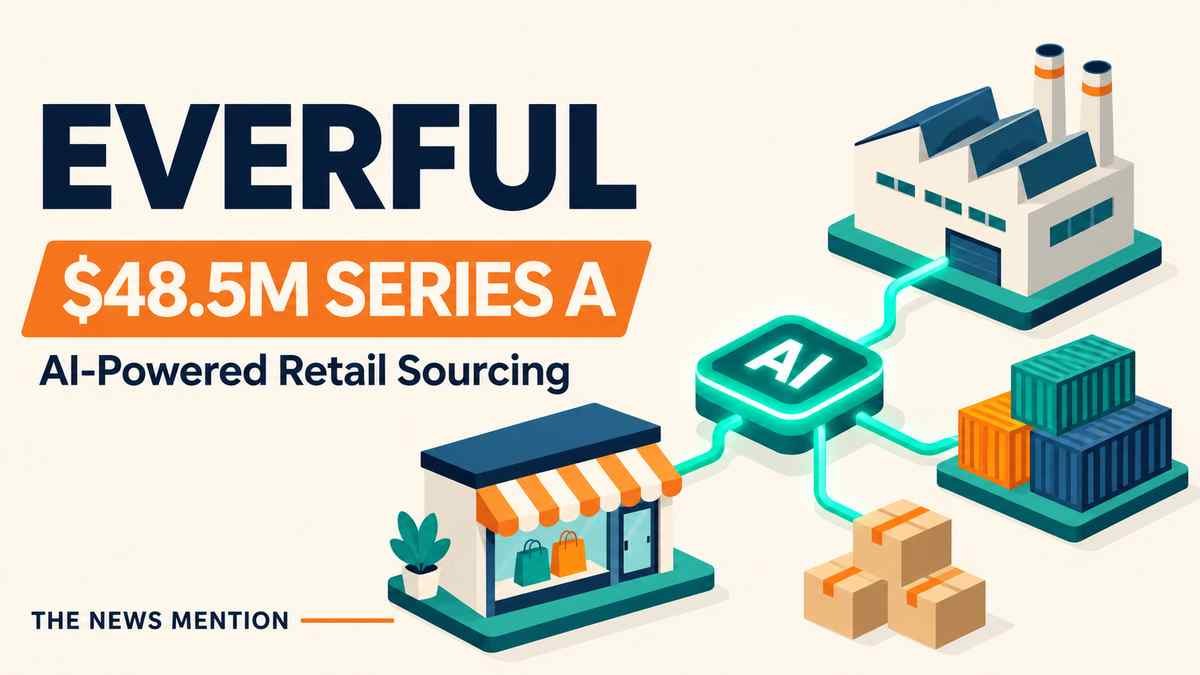
The Everful funding announcement puts a practical retail problem at the center of the AI investment story: how can a smaller business buy from overseas manufacturers without building its own sourcing department?
Everful announced a $48.5 million Series A on November 19, led by Vertex Ventures Southeast Asia & India and January Capital. Existing investors Square Peg and Lightspeed also participated. The company plans to strengthen its U.S. and European presence while developing its AI agents and fulfillment infrastructure.
Its proposition combines supplier discovery with the work surrounding an order. For retailers, the potential benefit is simpler purchasing and coordination. Whether that becomes better margins or more dependable deliveries still depends on product quality, commercial terms and execution.
Everful funding: what the announcement confirms
The financing is a Series A investment round, rather than an IPO or a public stock offering. The announcement does not provide a valuation, investor ownership percentages or a detailed allocation of the money.
Everful says it ships more than five million pieces monthly, serves customers in over 60 countries and works with more than 30,000 vetted factories. It also reports a catalog exceeding 20 million items and a target of reaching $100 million in annualized revenue by year-end.
Those operating figures and the revenue outlook are company disclosures. They should not be read as independently audited results. Annualized revenue is also different from revenue already earned across a complete financial year; the announcement does not establish that Everful has recorded $100 million in annual sales.
The useful takeaway is the direction of the investment. Backers are financing a business that aims to coordinate sourcing and fulfillment through software and operational services. The funding itself does not establish a particular return for investors or a guaranteed saving for customers.
Who founded Everful?
Everful was founded in 2024 by Sisi Song and Kevin Han. Song previously worked at Alibaba and Bessemer Venture Partners. Han is an AI entrepreneur whose earlier company, Orbeus, was acquired by Amazon. Their backgrounds connect cross-border commerce with AI development.
The company’s website describes its beginnings as Factory Price Jewelry and its subsequent expansion into broader wholesale categories. Its current storefront includes jewelry, accessories, home and kitchen products, clothing and other merchandise.
That history helps explain the platform’s focus on stock that smaller shops and brands can purchase and resell. It also sets an important boundary: buyers should check the availability and requirements of their particular product rather than assume every kind of manufacturing project is supported.
What does the Everful AI sourcing platform do?
Everful describes a system that links information about customer demand, factory capabilities and fulfillment. Its stated AI-agent tasks include identifying products, finding and assessing factories, and managing order communications. The company says inspection information feeds its factory-quality scoring.
It offers wholesale purchasing, dropshipping and customization, according to its announcement. These are different commercial arrangements. A retailer buying inventory for a shop needs a different delivery and return process from a merchant sending individual orders directly to customers.
The distinction matters when assessing a B2B eCommerce platform. A product listing answers what appears to be available. A completed sourcing arrangement also needs agreed specifications, prices, responsibilities and a route for resolving problems. Buyers should establish which of those responsibilities their chosen service actually accepts.
Everful uses the phrase “world model” for its supply-and-demand system. In this context, it describes the company’s approach to organizing commerce data. The label alone does not prove forecasting accuracy, supplier reliability or a particular level of automation.
Why direct factory sourcing appeals to smaller retailers
The practical appeal of direct factory sourcing is control over purchasing decisions. A buyer may want access to a wider assortment, smaller test orders or a clearer view of production options. An integrated service could make those tasks easier to manage, but the benefits should be checked against an actual order.
Testing products with less inventory exposure
Everful’s storefront advertises no minimum orders, while its financing announcement describes low minimums. Buyers should confirm the applicable quantity for the specific item, customization request and delivery destination. A general storefront statement is not a substitute for the final quotation.
A sensible approach is to test a manageable assortment before increasing quantities. Decide in advance what would justify a reorder: acceptable quality, sell-through, customer feedback and an achievable replenishment date. Smaller orders only reduce exposure when their total costs and commercial terms remain workable.
Reducing coordination work
The operational opportunity is to reduce repeated messages, manual comparisons and fragmented order tracking. A retailer evaluating retail supply chain automation should ask for a demonstration using its own purchasing requirements. Observe how missing information, changed specifications and delayed responses are handled.
Time savings should include the work moved elsewhere. Fewer supplier emails are useful, but additional checking, corrections or disputes can absorb the apparent gain. Our AI workflow ROI template explains how to account for review time and rework when assessing automation.
Supporting a broader product range
A wider wholesale catalog may help a retailer explore related categories. The buying decision should still follow its customer demand and brand positioning. Catalog size alone says little about whether an individual product will sell, arrive on time or meet the required standard.
Before expanding, compare each proposed category with the shop’s existing assortment. Consider storage, packaging, customer support and the effort needed to assess quality. A smaller selection that fits the business can be easier to manage than a large collection of unrelated products.
AI agents for supply chains still need approval boundaries
AI-powered supply chain management becomes more consequential when software moves from suggesting products to coordinating transactions. Buyers should separate tasks that can run with limited supervision from decisions that require explicit approval.
A useful starting boundary is to let software organize information while named staff approve commercial commitments. Product substitutions, higher spending, changed delivery arrangements and revised specifications deserve clear escalation rules. These are recommended controls, not a description of Everful’s contractual settings.
Ask whether the platform keeps a record of quotations, approvals and changes. When a discrepancy appears, the team should be able to identify the version that was accepted and the person who accepted it. An activity log is particularly useful when several employees or suppliers contribute to one purchase.
Teams planning broader adoption can use an employee AI acceptable use policy to define approved tools, permitted data and review responsibilities. The policy should match the workflow people actually use, including any purchasing or inventory systems connected to the service.
Compare landed cost before comparing supplier prices
A factory quote is only one part of a purchasing decision. Ask for a written breakdown covering the goods, packaging, customization, inspection, transport, insurance where applicable, customs-related charges and final delivery. Confirm what is included and what can change.
Keep the comparison consistent. Quotations should cover the same specification, quantity, currency and delivery assumptions. A cheaper unit price can be difficult to interpret if one offer excludes services that another includes.
Also establish when money becomes payable. Deposits, balance payments and refund arrangements affect working capital. Match those obligations with the expected delivery and selling period before deciding how much stock the business can reasonably carry.
For U.S. imports, Customs and Border Protection guidance explains that the importer of record has reasonable-care responsibilities concerning entry, classification and valuation. A sourcing service’s involvement does not justify assuming those responsibilities disappear.
Because cross-border commerce rules depend on the goods and destination, this article does not apply a universal tariff rate. Obtain current advice for the actual shipment and confirm the importer-of-record arrangement before paying. Readers outside the United States should check their own destination’s requirements.
Quality checks should be specific to the product
Everful promotes dedicated inspections and factory vetting. Buyers should ask what each check covers, when it occurs and what evidence they receive. A general quality-control statement does not explain the acceptance standard for a particular order.
Prepare a written specification before requesting samples. It should identify the features that matter to the purchase, such as dimensions, materials, finish, packaging and labeling. Where a product has applicable safety or compliance requirements, confirm the required documentation with a qualified specialist.
Then agree how a failed check will be handled. Can the goods be reworked, replaced or refunded? Who pays additional transport costs? What evidence is needed to raise a claim? Resolving those questions before production is more useful than relying on a broad reassurance afterward.
Avoid treating a successful sample as proof of every future batch. Keep records from the pilot and compare later deliveries against the accepted specification. The appropriate level of inspection depends on the product and risk, rather than the size of the funding announcement.
A practical way to evaluate Everful before committing
Start with a defined purchasing need and a limited pilot. This makes it easier to distinguish the platform’s performance from changes in assortment, demand or staffing.
Specify the order and responsibility
Record the product, quantity, required delivery window and acceptance conditions. Identify the contracting seller, who handles fulfillment and who responds to claims. Ask for the applicable terms in writing, including any service exclusions.
Check the supplier and data arrangements
Ask how factories are assessed and how inspection evidence is made available. Review which business information the service needs, who can access it and how access can be removed. Our AI vendor due diligence checklist provides a structured starting point for requesting evidence.
Measure the complete result
Track the delivered cost, lead time, administrative effort and the condition of the goods received. Record discrepancies and how they were resolved. Compare those outcomes with the original requirements before increasing order size or expanding into another category.
This approach gives a buyer evidence it can use. It also prevents the funding news from becoming the main reason for a purchasing decision. Financial backing may support development, but the relevant test is the service delivered under the customer’s own terms.
What the Series A means for global retail sourcing
The Everful Series A funding highlights investor interest in applying AI to the operational work of commerce. Its proposed value lies in connecting product selection, supplier coordination and fulfillment within a service that smaller businesses can use.
That is a credible business problem to address. The open question is how consistently the platform can deliver the promised experience across products, destinations and order types. Public announcements do not provide enough evidence to settle that question for every buyer.
For retailers assessing Chinese factory sourcing, the strongest response is practical: examine the terms, verify product requirements and run a controlled order. Use the result to decide whether the service improves purchasing for the business.
Everful funding gives the company resources to pursue its expansion plans. Customers should judge the next stage through dependable deliveries, clear accountability and demonstrable value. Those outcomes will matter more to a shop’s daily operations than the size of the round.
FAQs
How much funding did Everful raise?
Everful announced $48.5 million in Series A funding on November 19, 2026. Vertex Ventures Southeast Asia & India and January Capital led the round, with participation from existing investors Square Peg and Lightspeed.
Who are Everful’s founders?
Sisi Song and Kevin Han founded Everful in 2024. Song previously worked at Alibaba and Bessemer Venture Partners. Han previously founded Orbeus, which was acquired by Amazon.
How does Everful use AI for sourcing?
Everful says its agents help identify products, assess factories and manage order communications using supply-and-demand information. These are company-described capabilities. Buyers should confirm the scope, approval controls and service terms for their intended workflow.
Does Everful require minimum orders?
Its website advertises no minimum orders, while the funding release refers to low minimums. Confirm the requirement for the chosen product and any customization, shipping or destination conditions before placing an order.
Has Everful already earned $100 million in annual revenue?
The announcement says Everful is on track for $100 million in annualized revenue by year-end. That is a company-reported target, not confirmation of $100 million in completed full-year revenue or independently audited sales.
Does factory-direct sourcing guarantee a lower total cost?
No. Compare the complete delivered cost and terms, including relevant transport, inspection, customs and handling charges. A lower quoted product price does not by itself establish a cheaper or more suitable purchase.
Information verified as of November 20, 2026.
